


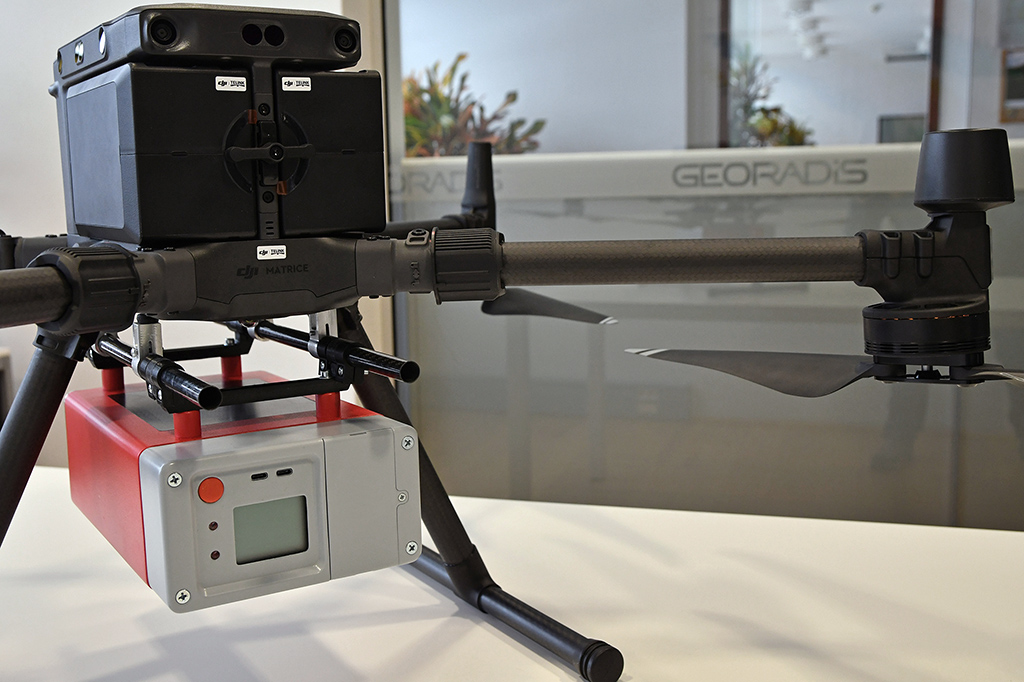
The D230A is a modular gamma-ray spectrometer designed specifically for UAVs. It lets operators measure and map the total intensity of gamma radiation and the intensity of the energy windows corresponding to potassium, uranium and thorium, as well as a wide range of man-made radionuclides. The standard system uses two fully independent 1024-channel spectrometers — each with its own detector and a small, lightweight data-acquisition and control unit. Spectra from both detectors are accumulated and saved separately at a sampling rate adjustable from one second up to one minute, and both contribute to an integrated spectrum, including dose rate, during monitoring.

Two fully independent 1024-channel gamma-ray spectrometers
One to four BGO or NaI(Tl) detectors, 2″ × 2″ (104 cm³) each
Automatic gain stabilization — no radioactive check source
Optional telemetric module for real-time wireless data
32 GB storage (~40,000 full spectra); supports all standard drones

The number of detectors in the D230A can be reduced to one to minimise the system’s weight, or increased to three or four to improve its sensitivity. Each 2″ × 2″ (51 × 51 mm, 104 cm³) detector is available as Bismuth Germanate Oxide (BGO) or Sodium Iodide (NaI/Tl): BGO offers about 3× greater sensitivity and is ideal for mineral exploration, while NaI/Tl is more lightweight and offers improved spectral resolution. Typical applications include mineral exploration (uranium directly, or rare-earth elements, gold and copper indirectly via thorium and potassium alterations), oil & gas exploration, environmental monitoring of uranium tailing ponds and the decommissioning of nuclear facilities and uranium mines, and industrial process and integrity inspection using radioisotope tracers.
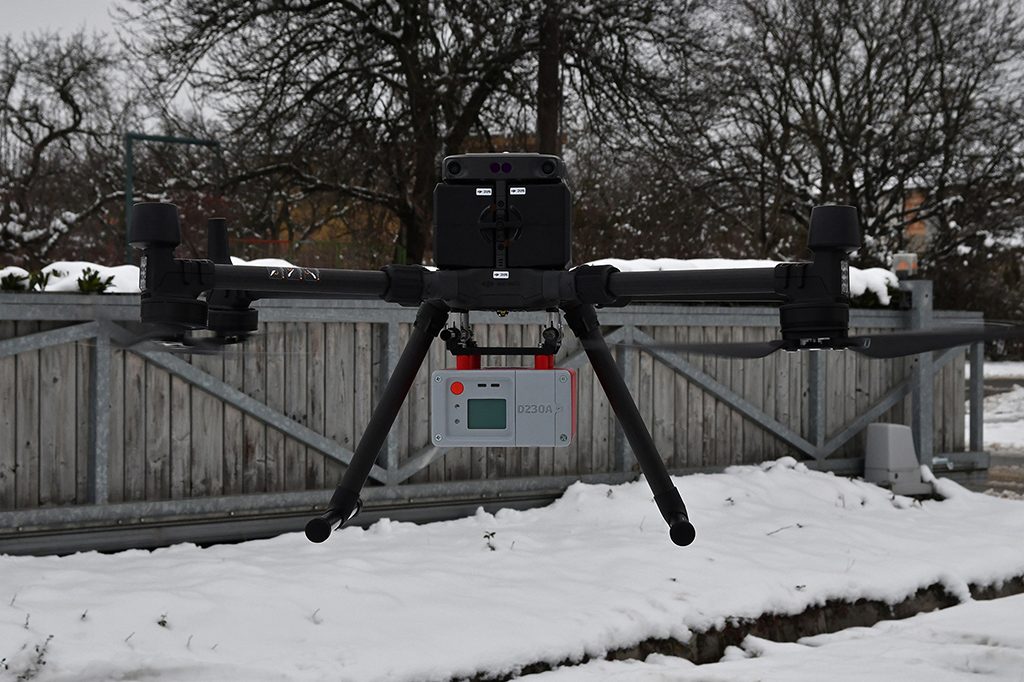
Airborne survey
Complete surveys far faster than ground instruments, without the cost of a large airborne system
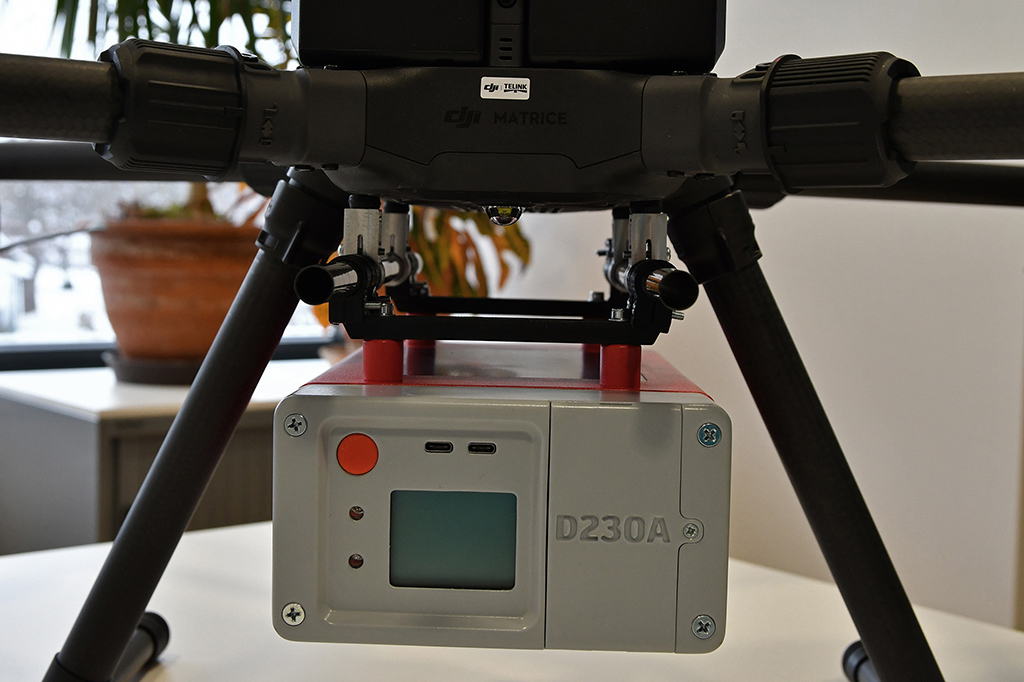
Single-button console
One button powers the system and control measurements — counts, spectra, nuclide ID and dose rate captured together
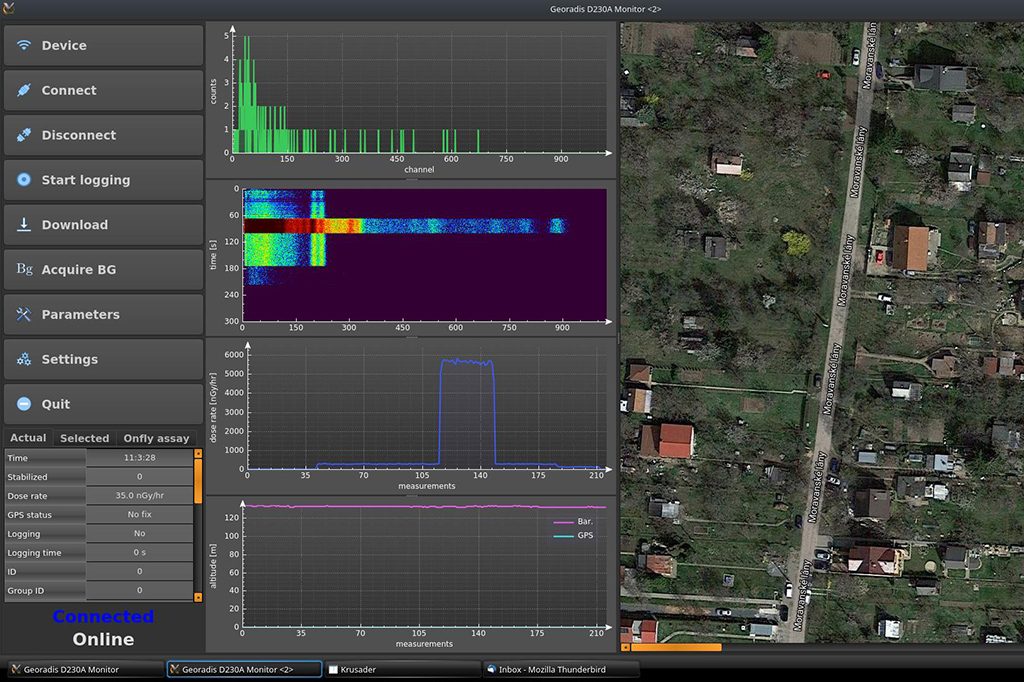
MapView software
In a bundle, for PC. Real-time spectra, dose rate, elevation, atmospheric pressure and GPS position
| Parameter | Value | Notes |
|---|---|---|
| NaI(Tl) or BGO, 2″×2″ (51 × 51 mm), 104 cm³ | 1 to 2 detectors | |
| 1024-channel per detector, 40 MHz DSP, pile-up rejector | 200 ns, max 250,000 cps/detector | |
| ≤ 8% FWHM NaI(Tl), ≤ 11.5% BGO (661 keV) | Cs-137 | |
| 25 keV – 3,000 keV | – | |
| energy-compensated 30 keV – 1.5 MeV, linear to 100 µSv/h | IEC 60486-1, sensitivity 1 nSv/h | |
| user-selectable, minimum 1 per second | separate + integrated spectra | |
| 32 GB, ~40,000 full spectra with GPS coordinates | expandable | |
| precision 2 m | −162 dBm nav, −148 dBm coldstart | |
| USB 2.0 | optional telemetric module (wireless) | |
| Li-ion 7.2 V / 2200 mAh | min. 4 h at 20 °C, hot-swappable | |
| 145 × 78 × 260 mm (1–2 detectors) | +78 × 78 × 260 mm per extra detector | |
| B&W LCD 104 × 81 px, single-button operation | – | |
| −10 °C to +50 °C | IP40 (not dust/water resistant) | |
| 2.7 – 6.5 kg | varies with configuration (see below) |
D230A detector configurations
| Configuration | Weight | Best for |
|---|---|---|
| 2.7 kg | lightweight, best spectral resolution | |
| 3.5 kg | higher sensitivity – mineral exploration | |
| 6.5 kg | maximum sensitivity |