


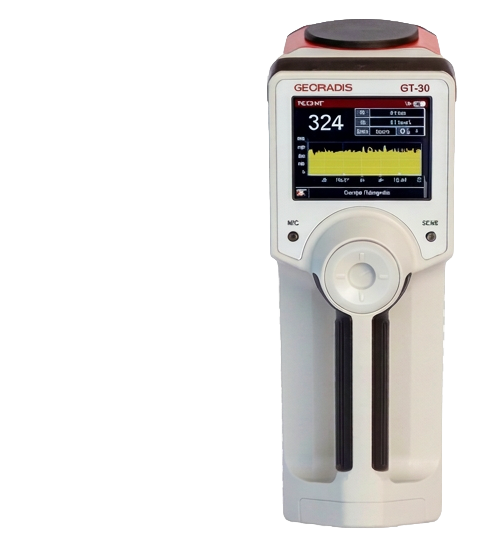
The GT-30 MkII is the second generation of the popular handheld gamma-ray spectrometer GT-30. It keeps the strengths of the first generation — a strong alloy body sealed against dust and water, a protective removable rubber boot, a comfortable grip and low weight — and adds a large colour trans-reflective sun-readable display, an improved user interface with five operation buttons, a removable but well-sealed battery cartridge and clear, loud audio. A 2″ × 2″ NaI(Tl) detector and a fully digital 1024-channel spectrometer give excellent sensitivity and the highest detector-to-unit-volume ratio in its class.

2″ × 2″ NaI(Tl) detector, 104 cm³, 20–3000 keV
NORM (KUTh) assay by least squares, up to 6 nuclides
3.5″ trans-reflective colour display, sun readable
Automatic stabilisation on natural background
IP-65, USB-C, Wi-Fi & Ethernet, built-in GNSS

The GT-30 MkII is built as an open platform, so special features requested by customers can be implemented quickly. A wide fleet of scintillation detectors is supported, using either traditional vacuum photomultiplier tubes or up-to-date silicon photomultipliers (SiPM) — and because SiPMs need far less volume than a vacuum tube, they leave room for a larger crystal in the same housing. At the heart of the instrument an FPGA works alongside a fast, low-consumption ARM processor, a combination proven in Georadis’ larger airborne and carborne systems. The implemented least-squares method determines the concentration of up to six elements or mixtures, which suits NORM measurements combined with man-made contamination such as Cs-137. Typical applications include mineral and rare-earth-metal exploration, uranium exploration, geology and geophysics, environmental monitoring, nuclear facilities, waste recycling, production facilities and construction-material control. The BGO version of the same platform is the GT-32 MkII.
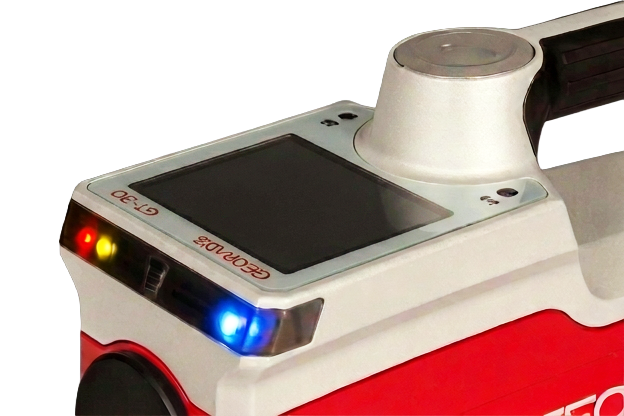
Colour display & joystick
3.5″ trans-reflective display with 5-position joystick
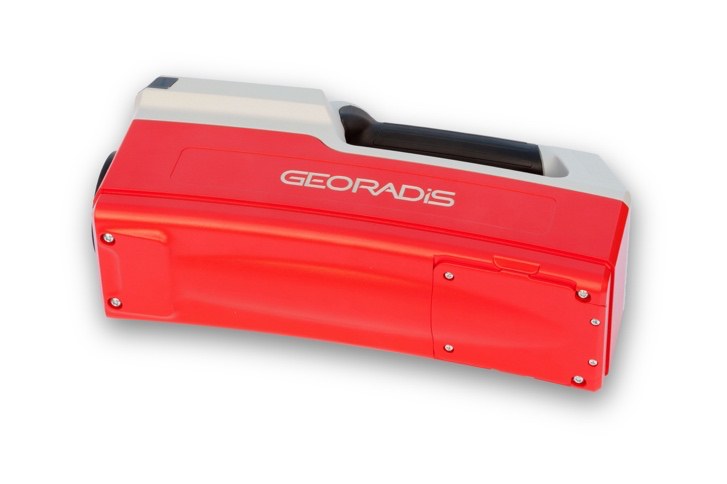
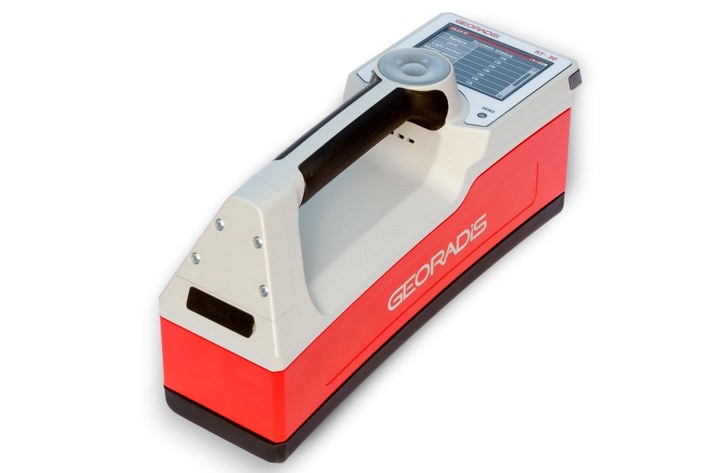
Sealed body & battery
IP-65 alloy body with replaceable Li-ion cartridge
NORM assay in the field
KUTh concentrations by least-squares spectrum fitting
| Parameter | Value | Note |
|---|---|---|
| NaI(Tl), ø 51 × 51 mm (2″×2″), 104 cm³ | GT-30 MkII standard option | |
| CsI(Tl), CsI/Eu, BGO, GAGG, YAP | ø 51 × max 120 mm with SiPM array | |
| 1024-channel, 40 MHz DSP, pile-up rejector 200 ns | linear energy corrected | |
| 20 keV – 3.0 MeV | 1024 channels, lookup-table linearisation | |
| 160 cps/MBq (Cs-137) at 1 m | 75 (Am-241), 270 (Co-60) | |
| energy-corrected air kerma Ka & H*(10) | 10 nGy/h – 80 µGy/h (Cs-137) | |
| 20 samples/s, moving average & integration | acoustic & visual alarm, 4 LED indicators | |
| least-squares fitting of whole spectrum | up to 6 nuclides in a blend, with std. deviation | |
| colour LCD 360 × 240, 72 × 54 mm (3.5″) | trans-reflective, automatic backlight | |
| illuminated 5-position navigation joystick | operable with gloves | |
| 32 GB, min. 8000 samples with full spectra | spectra, profiles, dose, position, voice message | |
| USB-C, Wi-Fi, Ethernet | internal GNSS GPS/QZSS/GLONASS, 56 channels | |
| Li-ion 7.2 V / 6600 mAh | min. 8 h at 20 °C, USB-C 60 W adapter | |
| 290 × 100 × 160 mm, 2.45 kg | IP-65, −10 to +50 °C |
GT-30/32 MkII detector options
| Model | Scintillator | Crystal size | Photomultiplier |
|---|---|---|---|
| NaI(Tl) | ø 51 × 51 mm, 104 cm³ | vacuum PMT | |
| BGO | ø 51 × 51 mm, 104 cm³ | 2″ bialkali | |
| CsI(Tl), CsI/Eu, GAGG, YAP | ø 51 × max 120 mm (2″ × max 5″) | SiPM / MPPC array |